Thursday, November 26, 2009

Mr. Singh Goes to Washington


Ashley J. Tellis
YaleGlobal , 23 November 2009

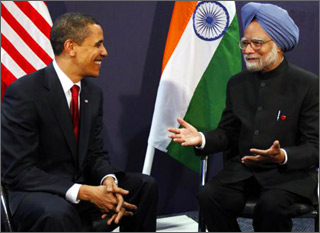
WASHINGTON: India’s Prime Minister, Dr. Manmohan Singh, will return to the White House on November 24, 2009, for the first state visit of the Obama administration. That fact itself is newsworthy. Both Washington and New Delhi will portray this event as evidence of the mutual commitment to sustaining the bilateral partnership that was transformed by President George W. Bush’s civilian nuclear agreement. The Obama team will go to great lengths to emphasize that Democrats too view India as an important country. Accordingly, it will match, if not exceed, in exquisite detail all the courtesies previously shown to Singh during his July 2005 visit to Washington.
But symbols alone will not be the hallmark of this occasion. Ever since Secretary of State Hillary Clinton visited India earlier this year, both countries have been fleshing out their five-pillared strategic dialogue: Expect, therefore, to find announcements about diverse new initiatives in such areas as agriculture, climate change, counterterrorism, economic cooperation, education, energy, public health, space, trade, and the like; if both sides are lucky, they might even be able to complete their negotiations over reprocessing U.S.-origin nuclear materials in time for the summit. These achievements have not come easily. The Obama administration is consumed by the domestic challenges of overcoming the economic crisis and managing healthcare reform while simultaneously addressing tricky foreign policy issues such as the war in Afghanistan, Iran’s nuclear program, the Israeli-Palestinian conflict, and reengaging Russia and China.
In these matters, India is viewed by the White House as mostly peripheral: important in itself no doubt, but no longer a pressing geopolitical priority. The decision to exclude mentioning India in Obama’s recent Tokyo speech, where he articulated his vision for Asia, confirms this point. Thus although both countries are comfortable conceiving their ties as a “global partnership,” there is an important difference in what both believe is necessary to maintain global order.
During the Bush administration, however, American and Indian perceptions were convergent on this score. Although the United States and India disagreed about much in the realms of, for example, multilateral trade expansion, democracy promotion, and the value of international institutions, these often profound differences were mitigated by their common strategic conviction that preserving the balance of power in Asia was indispensible to maintaining a stable international order.
While the global partnership between Washington and New Delhi during the Bush years was premised on such convergence, the Singh government now has to confront the reality of altered preferences pertaining to high politics in Washington. If speeches by various administration officials are any indication, the Obama administration has given notice that it has a very different view of the international system and, by implication, different priorities. Starting, for instance, from an assumption that the principal instrument for securing American interests globally is not the balance of power, but rather amorphous versions of cooperative security, Obama’s vision leaves New Delhi somewhat adrift.
Recognizing that the success of cooperative security ultimately depends on the presence of an underlying harmony of interests, India fears that the president’s approach will ultimately fail because of the deep rivalries between many Asian states. If peace and security are to be preserved in such an environment, power will continue to remain central, and only robust American power, supplemented by strong local partnerships, will be effective. Consequently, Indian policymakers have sought to emphasize the need for the United States to regain and reassert its strength along multiple dimensions, while simultaneously committing to empowering its friends and allies both symbolically and materially. Where New Delhi is concerned, this implies various things ranging from supporting India’s candidacy for permanent membership in the UN Security Council to increasing India’s access to advanced civilian and military technologies. Absent such efforts, collective security will not only prove to be a mirage, but it could also undermine Indian wellbeing, and with it the US-Indian global partnership desired by both sides.
It is unclear today whether the Obama administration appreciates these concerns. Its efforts to develop a “strategic partnership” with Beijing, which remains a geopolitical competitor of both the United States and India, raise unsettling questions about the president’s vision of global order. Many of these uncertainties would be easy to brush aside were it not for the rising Indian fears that the administration’s conception of cooperative security disguises what may become an evolving Sino-American condominium that places New Delhi at a deep disadvantage. The recent claim in the U.S.-China Joint Statement that both countries “support the improvement and growth of relations between India and Pakistan” only accentuates Indian anxieties since India has long opposed third-party intervention in the India-Pakistan dialogue. When supplemented by the myriad challenges of cooperation in such areas as climate change and trade and investment, the net effect has been to elevate mutual disagreements and bring them to the center of bilateral interactions—now without the cushion previously provided by the strong convergence on matters of geopolitics and national security. Both Obama and Singh, therefore, will have to make considerable efforts to sustain this partnership as it evolves in the face of altered fundamentals.
This reality often evokes counsels of despair among many in Washington and New Delhi. However justified these may be, there are still three reasons for hope. First, there is undoubtedly a convergence between U.S. and Indian interests on the central problem of international politics today: preserving a systemic balance of power that favors freedom. Even if the Obama administration presently chooses to disregard, or underplay, the necessity for preserving this balance, international political competition ensures that the demands of balancing will never permanently forsake the United States.
Second, both countries can still cooperate on many issues of high politics, even if the current administration appears disdainful about geopolitical balancing. Defeating terrorism and stabilizing Pakistan, arresting further proliferation, preserving security in the global commons, and, above all, aiding the United States in Afghanistan, offer opportunities for sustaining the bilateral partnership. And because India’s interests are at particular stake here, especially in Afghanistan, Prime Minister Singh ought to propose a bold, enlarged contribution to this war-torn country consistent with the priorities already agreed to with Washington.
Third, the gains from cooperation in areas of low politics should not be scoffed at because they promise to make a real difference to the lives of millions of ordinary Americans and Indians. Although likely to be spearheaded by the private sector in both countries, these activities still require assistance from both governments. To the degree that cooperation can occur in the areas of agriculture, education, energy, healthcare, science and technology, and women’s empowerment, they will contribute to strengthening the US and the Indian economies and, by implication, their national power.
Manmohan Singh’s visit to Washington, then, comes at the right time to insure against despondency. The bilateral discussions with Obama will provide him the opportunity to stress the geopolitical imperatives that brought both countries together, but equally importantly to warn of the dangers to Asian stability that could arise from American neglect of its friends and allies. In the end, both parties need to cooperate as meaningfully as possible until Washington wakes up from its present reverie, to rediscover the importance of preserving the balance of power in international politics.
Ashley J. Tellis is a senior associate at the Carnegie Endowment for International Peace and the author of “Reconciling with the Taliban? Toward an Alternative Grand Strategy in Afghanistan.”


Yale Global Online

Sunday, November 15, 2009

Why we will lose in Afghanistan


By Christopher Booker1
4 Nov 2009

As both Britain and America are plunged into an orgy of tortured introspection over what we are doing in Afghanistan, a further very important factor needs to be fed into the discussion, because it helps to explain not only why we have got into such a tragic mess but also why our armed intervention in that unhappy country is doomed.
What we are hardly ever told about Afghanistan is that it has been for 300 years the scene of a bitter civil war, between two tribal groups of Pashtuns (formerly known as Pathans). On one side are the Durranis – most of the settled population, farmers, traders, the professional middle class. On the other are the Ghilzai, traditionally nomadic, fiercely fundamentalist in religion, whose tribal homelands stretch across into Pakistan as far as Kashmir.

Ever since Afghanistan emerged as an independent nation in 1709, when the Ghilzai kicked out the Persians, its history has been written in the ancient hatred between these two groups. During most of that time, the country has been ruled by Durrani, who in 1775 moved its capital from the Ghilzai stronghold of Kandahar up to Kabul in the north. Nothing has more fired Ghilzai enmity than the many occasions when the Durrani have attempted to impose their rule from Kabul with the aid of "foreigners", either Tajiks from the north or outsiders such as the British, who invaded Afghanistan three times between 1838 and 1919 in a bid to secure the North-west Frontier of their Indian empire against the rebellious Ghilzai.
When the Soviets invaded Afghanistan in 1979, after years of Durrani rule, it was to support a revolutionary Ghilzai government. But this new foreign presence inspired general Afghan resistance which was why, by the late 1980s, the Americans were supporting the almost entirely Ghilzai-run Taleban and their ally Osama bin Laden. In 1996 the Taleban-Ghilzai got their revenge, imposing their theocratic rule over almost the whole country. In 2001, we invaded to topple the Taleban, again imposing Durrani rule, now under the Durrani President Karzai.
As so often before, the Ghilzai have seen their country hijacked by a Durrani regime, supported by a largely Tajik army and by hated outsiders from the West. One reason why we find it so hard to win "hearts and minds" in Helmand is that we are up against a sullenly resentful population, fired by a timeless hatred and able to call on unlimited support, in men and materiel, from their Ghilzai brothers across the border in Pakistan.
Only in towns such as Sanguin and Garmsir are there islands of Durrani, willing to support the Durrani government in distant Kabul. No sooner have our forces "secured" a village from the Taleban, than their fighters re-emerge from the surrounding countryside to reclaim it for the Ghilzai cause. Without recognising this, and that what the Ghilzai really want is an independent "Pashtunistan" stretching across the border, we shall never properly understand why, like so many foreigners who have become embroiled in Afghanistan before, we have stumbled into a war we can never hope to win.

The Telegraph

Friday, November 13, 2009

Bypassing the aid trap in Pakistan


By Glenn HubbardFriday,

November 13, 2009

Congress recently approved $7.5 billion in aid to Pakistan for social and economic development. The bill incited controversy by requiring that the U.S. secretary of state report to lawmakers on whether Pakistan's civilian government keeps effective control over its military, because many observers accuse some in the Pakistani military of having tolerated or even aided Islamic extremists since the 1980s.
But the bill itself should raise questions. After all, does Pakistan, or the U.S. Agency for International Development, or any other agency that will implement the aid actually know how to successfully spend these funds? In other parts of the world, especially Africa, foreign aid has been a spectacular failure in promoting social and economic development. This bill promises more of the same.
The United States has given Pakistan more than $10 billion in development aid since 1954. What has become of those funds? It certainly has not helped produce the kind of stability and prosperity that would help Pakistan offer its people an alternative to extremism. Nor has aid worked in Africa. Nothing indicates that an additional $7.5 billion will yield better results.
All, however, is not yet lost. It will take time to disburse and spend the funds, and there could be a chance to recast the support in a more promising way. There is even an example of effective large-scale aid on which to draw: the Marshall Plan of postwar Europe, which is still recognized as the most successful aid program in history.
The essence of the Marshall Plan was loans to local businesses, which paid them back to their local governments, which used the money for commercial infrastructure to help those same businesses. The result was economic growth, employment and a stable middle class that opposed the popular communist parties across Europe. With creative adaptation, the same basic model can work in Pakistan.
Economic aid to Africa and Pakistan has tended to be allocated to government-directed development projects. More recently, such aid has funded projects by nongovernmental organizations (NGOs), too. But all of the world's prosperous countries became rich through the growth of a domestic business sector. India and China are the most recent examples of this. A thriving local business sector is the only known path to prosperity and stability.
Some might argue that Pakistan is too different from postwar Europe for a Marshall Plan to work. But consider Greece, a poor and war-torn nation when the Marshall Plan was implemented. By the time the plan was ended, Greece was well on its way to prosperity. This model can be reinterpreted to best suit the Pakistan situation: The kinds of loans can vary widely, and the commercial infrastructure can range from training for accountants to the more traditional ports and roads.
The World Bank's Doing Business index ranks countries by how easy it is for citizens to start and run businesses. Among the 183 nations ranked, most of sub-Saharan Africa falls in the bottom half. Pakistan, at No. 85, is less anti-business than most poor countries, so a Marshall Plan there has a reasonable chance of success.
Right now, nothing in the package suggests that this $7.5 billion will do any better than previous development aid, largely because government and NGO aid projects make it harder for prosperity to take root. Aid projects hire qualified staff away from local businesses. For example, they deliver fertilizer to farmers instead of a local business doing it. And they remove incentive for Pakistan to make reforms that foster business development. After all, why make it easier for business when government and NGO projects give out so much money?
But a Marshall Plan would help Pakistan's efforts to encourage its local business sector. The efforts are there: In August, Prime Minister Syed Yousaf Raza Gilani established the first Business Persons Council; it has 53 members from the local business community and is headed by the minister of finance. The council is to meet monthly "to recommend measures for improvement in business climate in Pakistan and develop a business and trade sector strategy for the country." This is a major shift from tradition, in which the government Planning Commission was solely in charge of economic policy. Foreign aid should work with this new effort rather than at cross-purposes with it.
Former secretary of state George Marshall famously suggested fighting the spread of communism in Europe through local business. That strategy could contribute to the battle against Islamic extremism. The current aid package should become a Pakistan Marshall Plan -- before it's too late.

Glenn Hubbard, dean of Columbia Business School and a former chairman of the White House Council of Economic Advisers, is the author of "Aid Trap: Hard Truths About Ending Poverty."


Washington Post

Sunday, November 8, 2009

The Observer debate: Should we bring our troops home from Afghanistan?


Peter Beaumont and Jason Burke
08 November 2009


Yes: We've lost sight of our aims. I'm no longer sure why we're there
Peter Beaumont, the Observer's foreign affairs editor, says the terms for a satisfactory end to conflict and the purpose of our presence are so ill-defined as to be almost indecipherable
Why are we fighting in Afghanistan? I ask because I am no longer sure. And not being sure, like a majority of Britons, I cannot conceive what victory might look like. That makes me think we should not be there. Once, I recall, the idea was to help create the beginnings of a modern, democratic state where the lives of ordinary people would be improved. Women's rights would be supported and a free press encouraged. War lords trundled off the scene. What are our aims in Afghanistan right now?
The reality is that the disappearance of the rhetoric of rebuilding since Obama became president has left a gaping wound at the core of a policy now centred on attempting to strengthen the legitimacy of a corrupt, nepotistic Afghan government and its security institutions. My views have not been prompted by the events of last week – the death of five British soldiers shot by an Afghan policeman. For, despite the hurt for the families of the dead men, as a solitary event, it tells us nothing much we can usefully extrapolate about the meaning of war.
Instead, my disillusionment began during a month-long trip to Afghanistan last year. I came away convinced the war was failing and the claimed victories often hollow things. What bothered me most was a problem of definition of the dynamics of the conflict: the realisation that the Taliban, whether I liked it or not, were more representative of a facet of the country than any outsiders.
The question of what we are doing in Afghanistan is crucial not least because there tend to be two kinds of war. In wars of "supreme emergency", as Winston Churchill described the conflict of national survival that was the Second World War, the political is largely subordinated to military contingency. In the other category of war, the kind being conducted in Afghanistan today that falls outside of the definition of emergency, it might be expected that the military strategy should be subordinated to clearly enunciated political ambitions.
Yet when it comes to Afghanistan, not only the terms for what would be a satisfactory and honourable conclusion to the conflict but also what purpose our continuing war serves there have become so ill-defined as to be almost indecipherable.
On Friday, Gordon Brown attempted once again to define Britain's vital and necessary interest in fighting a war in Afghanistan, a performance that was striking in its incoherence and internal contradictions. On one hand, Brown argued that it was a conflict that must be "prosecuted out of necessity" to protect this country and the wider world from terrorism. On the other, he warned President Hamid Karzai that in a country that had become a "byword for corruption" and cronyism, he would no longer put Britain's soldiers in harm's way unless Karzai improved.
Brown's definition of necessity, then, is an odd one. Far from being an absolute, according to Gordon Brown and his speech writers, the war could become less necessary should Karzai not mend his ways. It is an important point because the notion of necessity is regarded by moral theorists of conflict as critical in defining whether war is justifiable. Many recognise that for a war to be necessary and therefore just, it must meet two criteria: relating to both the imminence and the nature of the perceived threat.
This raises a second important question: whether the continuation of the war in Afghanistan can be justified, in any case, when it is so narrowly framed in terms of a potential terrorist threat. For while terror is always awful and often deeply socially corrosive, in the vast majority of cases it is not something that poses an existential threat to national survival. Parsed in this way, what Brown appears to be arguing for is a conflict that serves the function of a counterterrorism strategy at long distance, conducted, despite his protestations that it is not a war of choice, with such conditions now attached to make it an elective conflict.
The cause of the war camp has not been assisted by the sense of deep paralysis over Afghanistan that has been emanating from the White House. There have, it is fair to say, been other arguments proposed for continuing with the war far more cogent than Brown's. Paddy Ashdown, the man once slated for the role of UN envoy to the country before he was vetoed by President Hamid Karzai, has framed it in terms of regional stability. If Afghanistan falls to the jihadis, Ashdown suggested last week, then Pakistan – a nuclear armed state – risks being next.
Others have made the case for continuing the war on humanitarian grounds. The consequence of the departure of foreign troops, they say, would lead to renewed civil war and a betrayal of the Afghan people who thought they had been promised so much. A fair and understandable concern.
Yet it is what we have made in Afghanistan that concerns me the most: a shabby accommodation with crooks, drug dealers and warlords, and with electoral bandits such as Karzai whose survival is only possible because of the international mission which props him up, even as it grows ever more weary of its protege. Karzai has cosied up to many of the war lords who once tore Afghanistan apart, who include his running mate and now vice president, Marshal Fahim, a man accused by Human Rights Watch of having the "blood of many Afghans on his hands". We have put police uniforms on the back of militiamen with more loyalty to tribal figures than the Ministry of the Interior, and built up a national army in which the majority Pashtuns are badly under-represented.
The consequence has been a country-wide crisis of legitimacy and authority, exacerbated by widespread feelings among Afghans that those in power, at every level, operate with almost complete impunity.
The terrible tragedy here is that in the aftermath of the fall of the Taliban following 9/11 there was probably an opportunity to transform a country so long convulsed by conflict that was squandered by incompetence, wrong-headedness and lack of attention to its problems as the war in Iraq was launched.
The difficulty is that I still can't see what victory would look like. Or even something close to it. So what are required now are the same words delivered by Obama to US Marines at Camp Lejeune on 27 February this year that comprised a road map for the end of the conflict in Iraq. I've changed only one word. "Today, I have come to speak to you about how the war in Afghanistan will end. To understand where we need to go, it is important... to understand where we now stand."
Because without an end in sight, without the knowledge that we will be leaving soon, without clear aims the public can understand, without terms to describe what a satisfactory conclusion might look like, the war in Afghanistan is a blank cheque written in the blood of Afghan civilians and the foreign soldiers fighting there. Drawn on a morally bankrupt account.
No: It would be a betrayal of the people we promised to stand by
Jason Burke, the Observer's expert on al-Qaida, says that now we have a new strategy in place under Barack Obama, we owe it to the Afghans to do our utmost to make it succeed
It was November 1999. The winter was closing in, a sharp wind blew through the deserted streets of Kabul and a hard, cold rain drummed on battered iron roofs. There was almost no electricity, a handful of telephone lines, a single restaurant. In the city's rundown stadium, I watched a woman convicted of murdering her husband executed and two thieves have their hands amputated. In a hospital, mothers knelt helplessly beside their starving, chronically ill children. That the Afghans were abandoned by the west was taken as the normal state of affairs. No one saw any reason that this should change soon.
That view was understandable. The west had been happy to aid the Afghans' resistance in their brutal fight against Soviet occupiers in the 1980s, but had then made no serious effort to stabilise, reconstruct or develop the country after the war's end in 1989. No real effort had been made either to halt the civil war of the 1990s or help its victims. And the only foreigners who Afghans saw by the end of the decade were rare NGO workers or reporters.
The west did suddenly get interested in Afghanistan again. Not through any sudden fit of altruism but because Osama bin Laden, a Saudi, launched a successful attack in America. In the post-cold war world, Afghanistan had been a shadowy corner on the geopolitical stage. Post 9/11, it found itself blinking in the spotlight. Now, after eight years of war, the world is getting tired of this truculent, gritty country and it seems it is time for Afghanistan and Afghans to bow out once again.
That we in Britain should be debating an withdrawal of our forces from Afghanistan is healthy and right. No one wants to keep our soldiers there any longer than necessary. That we should even be contemplating a precipitate and unilateral departure is a betrayal of all those in Afghanistan who once believed, often against their better judgment, our promises to, for once, stand by them.
Events since those dark days at the end of the 1990s have brought more than many Afghans ever hoped for and more than most ever feared. The west has got some things right, but has got many badly wrong. Our actions have been marked by miserliness, misunderstandings and muddleheaded stubbornness. Even in 2002 and 2003, when Afghans of every background were optimistic about the western presence in their country, the levels of resources dedicated to what was then seen as a "peacekeeping/nation-building" operation remained among the lowest of any such intervention of recent years.
Proportional to the population, a tenth of the international troops were deployed as in East Timor, a twentieth of those in Kosovo. The aid pledged, much of which never arrived, was per capita a sixteenth of that spent in the first two years of the intervention in Bosnia.
The realisation that the Taliban were back in force changed little. Troops were dripped in piecemeal through 2006 and 2007 despite an evident need for a radical change of approach. The nature of the fighting and of the enemy was totally misunderstood. In 2007, I watched a British patrol demolish a house with heavy machine guns, mortars, anti-tank missiles and finally a 500lb bomb dropped by a jet. The result was a single (unconfirmed) kill.
In the villages, locals turned to the Taliban rather than corrupt, inefficient judges and teenagers took up arms to fight "the invader" because what their clerics told them made sense. In Britain, politicians railed against Karzai, forgetting that he owed his position almost entirely to the continued support of the west. By 2008, the situation had deteriorated so far that, with the Taliban established in outlying districts of the city, friends in Kabul who had returned in 2002 were wondering where to go if forced to flee again.
Now, finally, with Barack Obama in the White House and an American military which, for all its faults, has shown an impressive ability to learn (or relearn), we have in place the strategy that we should have had years ago. It depends on restricting the air strikes and the indiscriminate firepower, deploying troops to protect the population rather than treating them as a neutral terrain on which to hunt insurgents, training local troops, creating secure physical space for commerce, political space for some kind of process potentially leading to the eventual creation of a broadly legitimate government structure linked to broader regional initiatives. But will this strategy work?
Probably not. Even key advisers admit that chances of success are limited. Errors made are too grave, structural problems inherent in the multinational effort too great, scepticism and fatigue of western domestic populations too deep. The Afghan National Army is far from the ethnically balanced institution it is supposed to be and expanding it risks aggravating fractures rather than building a new solidarity. The police are a catastrophe, opium is turning the country into a narco-state, support for the Taliban from elements within the Pakistani security establishment continues. To complicate things further, there is the fact that this is now an American war. Two-thirds of the troops in Afghanistan are American. At Bagram airport, there are more US helicopters held in reserve than we have in the entire country. A UK departure would prompt an unseemly rush of European nations for the exit but would not necessarily change much.
It is true that many arguments for staying engaged in Afghanistan are weak. Contemporary violent Islamic extremism is caused by a matrix of different social, economic, political, cultural and religious factors going back decades, if not centuries, in the Islamic world and in the Islamic world's relation with the west. Al-Qaida, based in Pakistan, only represents one element of the threat it poses, albeit currently the greatest. The link between defending Kandahar and protecting Kensington is indirect at best. The human rights argument is weak, too. It is almost certain that any stable Afghanistan is going to be much more conservative, much more anti-western and much more authoritarian than we would like. Better than a Taliban-run state perhaps but more like Saudi Arabia than Sweden. A continued commitment will not guarantee girls the right to go to school across the entire country.
So why fight then? Why send more young men to their deaths? Why spend more money that could be used for hospitals, schools or saving banks?
For the simple reason that we owe it to the Afghans to try to make the new strategy work. Every death is a tragedy, but the price in lives and money is not an exorbitant one given the size, wealth and military history of the UK. After years of errors, we finally have a chance to do something right. In two or three years, we will know if there is a chance that the strategy can succeed. If it does, we can be proud. If it doesn't, at least we are unlikely to have made things worse. More important, we can at least honestly say to the Afghan people that we did our best. It's more than we've ever been able to say to the Afghans before.
Three in favour of withdrawal
Paul Flynn
Ministers are spinning the end game to avoid blame. Gordon is pulling on rubber levers. Corruption is the irremovable lubricant of Afghan life. Most European countries have policed Afghanistan: we have done the dying. Canada and the Netherlands have announced exit dates. We must follow suit. We must fixed the inevitable deal. We should walk out in a phased withdrawal, not run out in panic as the Americans did from Saigon. Public opinion will revolt against more soldiers dying for a lost cause. The question now is who will be the last British soldier to die for politicians' blunders and vanity?
Paul Flynn is Labour MP for Newport West
Mary Warnock
There will never be a good time to pull out. Whenever we do, we can't just say that we're doing so because keeping troops there is too expensive, in lives and resources, and too hopeless of success. Most of us knew that all along. Nor did we accept the argument from self-defence.
But things have got so dramatically worse in the past week that we could argue that it's a crisis demanding decision.
We can't drift on in the nightmare for ever. Perhaps now is as good a time as any to announce withdrawal and shut our ears to the cries of triumph.
Mary Warnock is a philosopher and crossbench peer
Maureen Shearer
It's dreadful out there and it's getting worse. Iraq was bad, but Afghanistan seems to be worse. What must the parents of those killed be thinking? I can't see any point in staying there because I can't see what good we are doing. Nobody has managed to do anything there but die and now we have a corrupt government to support. Our lads died supporting the Afghan election. What did they die for? It appears the British government has no idea of where it is heading. Our approach to Afghanistan seems to be back to front. We should withdraw.
Maureen Shearer's 26-year-old son, Richard, was killed in Iraq in 2005
Three against withdrawal
Havana Marking
The government here is a nightmare, the UN is in meltdown and there is no leadership from the international community. A disastrous combination of personalities led to this and heads should roll. But should troops pull out? Absolutely not. This is a valid mission that should and could have created a stable, friendly nation in a vital region. The majority of the population do not support the Taliban. But we need a leader (Obama, step up) to take control and let the Afghan president know what his country will lose if he doesn't clean up his act.
Havana Marking is a documentary film director working in Afghanistan
John Nichol
The time has come to put up or shut up – we have tinkered around the edges of the Afghan problem for too long. In 2001, Operation Enduring Freedom was launched to liberate the people of Afghanistan from tyranny. Eight years on, there is still little evidence of any true freedom. If we are serious, Nato and the wider world must deploy not hundreds, but hundreds of thousands more troops in order to stabilise the country and then spend billions of dollars – as was promised – to rebuild a broken state.
John Nichol is a former RAF officer and PoW in the first Gulf war and author of Medic – Saving Lives From Dunkirk to Afghanistan
Robert Fox
British troops should be reinforced slightly to about 10,000 to help bring some stability to main centres of population. Afghanistan needs a tougher security plan under one allied supreme commander. Karzai must clean his act up. There should be a plan for reconciliation within Afghanistan for local Taliban and funding at village level to break the cycle of poverty. There has to be a timetable for international forces to pull out over the next few years, but there should be no public announcement about the details. That would give the Taliban a huge tactical advantage and condemn our troops to stay even longer.
Robert Fox is a defence correspondent and writer
The long war: a time line
2001: On 7 October, Tony Blair confirms that British forces are involved in US-led military action against al-Qaida training camps and the Taliban regime in Afghanistan. A month later, Royal Marines help secure the airbase at Bagram. With the Taliban pushed out of Kandahar in December, the Afghan Interim Authority, headed by Hamid Karzai, prepares to take office in Kabul.
2002: Blair visits Bagram airfield on 7 January, speaking to troops as they prepare for the deployment of a Nato-led International Security Assistance Force (Isaf). On 9 April, Private Darren George, 23, from the Royal Anglian Regiment, becomes the first British serviceman to die in Afghanistan since the invasion.
2004: Karzai wins presidential elections with 55% of the vote.
2006: 4,500 British troops are deployed to Helmand Province and engage in some of the most intense fighting seen by the army for half a century. British casualties rise to 44.
2007: Following heavy fighting by British and Afghan forces the Afghan defence ministry announces that the key strategic town of Musa Qal'eh in Helmand province has been recaptured from the Taliban
2008: Prince Harry serves with the army in Helmand. In June, the number of British dead passes 100. The UN number Afghan civilian deaths at 2,118, a rise of nearly 600 on 2007
2009: In July, 22 soldiers are killed and scores more wounded, and by August the UK death toll reaches 200 from where it will rise to 230. Elections on 20 August are declared corrupt. On 14 October, Gordon Brown announces he will send 500 extra troops to Afghanistan, taking the total to 9,500.


The Observer


Saturday, November 7, 2009

Winners and losers of 1989


Those who witnessed that night 20 years ago in Berlin, or elsewhere in Germany, will never forget what happened – the night the Berlin wall came down.
History in the making is all too often tragic. Only rarely is it capable of irony. But 9 November 1989 was one of those rare moments when irony reigned, because East Germany's bureaucratic socialism died as it had lived – with a bureaucratic snafu.
The speaker of the Politburo, Günter Schabowski, had simply misunderstood that body's decision and, by releasing to the public incorrect information about the lifting of travel restrictions, triggered the fall of the wall. Groucho Marx could not have bettered Schabowski that night. It was Germany's happiest hour.
Twenty years later, many revolutionary consequences of that night lie behind us. The Soviet Union and its empire quietly disappeared, and with them the cold war international order. Germany was reunited; eastern Europe and the states on the Soviet periphery won their independence; South Africa's apartheid regime fell apart; numerous civil wars in Asia, Africa and Latin America ended; Israelis and Palestinians came closer to peace than at any time since; and a disintegrating Yugoslavia degenerated into war and ethnic cleansing. In Afghanistan, war continued under different circumstances, with serious ramifications for the region and, indeed, the world.
As the victorious heir to the collapsed cold-war order, the United States stood alone, undisputed, at the peak of its global power. But, within two decades – following the war in Iraq and financial and economic crisis – the US had squandered that special status.
Arrogance of power and blindness about reality were the two main causes for the decline of the sole remaining superpower. While most of the blame lies with George W Bush, numerous negative trends had preceded him. He merely took them to the extreme.
After 11 September 2001, the US had a second big chance to use its unique power to reorganise the world. After that terrible crime, countries – including those in the Arab world – were ready to embrace far-reaching steps. At that moment, peace between Palestinians and Israelis could have been achieved, and thus a new beginning made in the Middle East.
Even a radical about-face in US energy policy, with the introduction of energy taxes, would have been possible under the banner of national security. The challenge posed by global climate change could have been addressed more effectively that way. But that opportunity, too, was thrown away.
Europe – and, within it, Germany – were among the big winners of 9 November 1989. The continent reunited in liberty: Germany on 3 October 1990; Europe with the great European Union enlargement of 1 May 2004. The introduction of a common European currency was successful; political integration by means of a constitutional treaty a failure. Since then, the EU has been stagnating, both internally and externally. Europe has made only insufficient use of its opportunities since 1989 – and could dramatically lose influence in the emerging power structure of the 21st century.
In Germany, which largely owes its reunification to its firm roots in the EU and Nato, Europe-weariness is palpable. The generation ruling in Berlin today increasingly thinks in national rather than European terms. This was never more obvious than in the deciding days and weeks of the global financial crisis.
Russia, the big loser of 1989, remains two decades later mired in a mix of social and economic depression, and political regression and illusion. Life expectancy continues to decline; investment in infrastructure, research, and education are stunted; the economy is barely able to compete internationally; and the social divide between poor and rich is deepening.
Economically, Russia has turned into a commodity exporter, dependant on the imponderables of the global energy market, while simultaneously dreaming that it can use energy as a tool to revise the post-Soviet order in its neighbourhood.
Russia's elites still largely think in the power categories of the 19th and 20th centuries. This constitutes the illusionary and historically regressive element of current Russian policy. Moscow's desire to reclaim its role as a powerful global player is understandable and legitimate. But if it turns toward the past in looking for its future, and if it believes it can dispense with investments in the future in favour of shameless personal self-enrichment, it will continue to lose ground.
That day in November 1989 marked not only the end of the cold war-era, but also the beginning of a new wave of globalisation. The real winners of this new world order are the large emerging countries, first and foremost China and India, which increasingly set the pace of global economic and political development.
The G8 has been dismissed by history as a club of western industrial nations; its place has been taken by the G20, which conceals the underlying formula of power distribution within the new world order: the G2 (China and the US). All these changes reflect a dramatic transfer of power from west to east, from Europe and America to Asia, which within the next two decades is likely to bring to an end 400 years of Eurocentrism.
The past two decades also have seen the world begin to reach its ecological limits. The majority of humanity has sought since 9 November 1989 to achieve western living standards at all costs, overstretching our planet's climate and ecosystems.
The years since the Berlin wall came down have been rich in dramatic change, but the real era of upheaval lies ahead. Global warming is only the tip of the iceberg towards which we are moving, knowingly, with eyes wide open. What matters now is that states act globally and in unison. Twenty years after Berlin, Copenhagen is calling.


Guardian


Friday, November 6, 2009

Obama and the U.S. Strategy of Buying Time


By George Friedman

Making sense of U.S. President Barack Obama's strategy at this moment is difficult. Not only is it a work in progress, but the pending decisions he has to make -- on Iran, Afghanistan and Russia -- tend to obscure underlying strategy. It is easy to confuse inaction with a lack of strategy. Of course, there may well be a lack of strategic thinking, but that does not mean there is a lack of strategy.

Strategy, as we have argued, is less a matter of choice than a matter of reality imposing itself on presidents. Former U.S. President George W. Bush, for example, rarely had a chance to make strategy. He was caught in a whirlwind after only nine months in office and spent the rest of his presidency responding to events, making choices from a menu of very bad options. Similarly, Obama came into office with a preset menu of limited choices. He seems to be fighting to create new choices, not liking what is on the menu. He may succeed. But it is important to understand the overwhelming forces that shape his choices and to understand the degree to which whatever he chooses is embedded in U.S. grand strategy, a strategy imposed by geopolitical reality.

Empires and Grand Strategy

American grand strategy, as we have argued, is essentially that of the British Empire, save at a global rather than a regional level. The British sought to protect their national security by encouraging Continental powers to engage in land-based conflict, thereby reducing resources available for building a navy. That guaranteed that Britain's core interest, the security of the homeland and sea-lane control, remained intact. Achieving this made the United Kingdom an economic power in the 19th century by sparing it the destruction of war and allowing it to control the patterns of international maritime trade.
On occasion, when the balance of power in Europe tilted toward one side or another, Britain intervened on the Continent with political influence where possible, direct aid when necessary or -- when all else failed -- the smallest possible direct military intervention. The United Kingdom's preferred strategy consisted of imposing a blockade -- e.g., economic sanctions -- allowing it to cause pain without incurring costs.


At the same time that it pursued this European policy, London was building a global empire. Here again, the British employed a balance-of-power strategy. In looking at the history of India or Africa during the 19th century, there is a consistent pattern of the United Kingdom forming alliances with factions, whether religious or ethnic groups, to create opportunities for domination. In the end, this was not substantially different from ancient Rome's grand strategy. Rome also ruled indirectly through much of its empire, controlling Mediterranean sea-lanes, but allying with local forces to govern; observing Roman strategy in Egypt is quite instructive in this regard.
Empires are not created by someone deciding one day to build one, or more precisely, lasting empires are not. They emerge over time through a series of decisions having nothing to do with empire building, and frequently at the hands of people far more concerned with domestic issues than foreign policy. Paradoxically, leaders who consciously set out to build empires usually fail. Hitler is a prime example. His failure was that rather than ally with forces in the Soviet Union, he wished to govern directly, something that flowed from his ambitions for direct rule. Particularly at the beginning, the Roman and British empires were far less ambitious and far less conscious of where they were headed. They were primarily taking care of domestic affairs. They became involved in foreign policy as needed, following a strategy of controlling the seas while maintaining substantial ground forces able to prevail anywhere -- but not everywhere at once -- and a powerful alliance system based on supporting the ambitions of local powers against other local powers.


On the whole, the United States has no interest in empire, and indeed is averse to imperial adventures. Those who might have had explicit inclinations in this direction are mostly out of government, crushed by experience in Iraq. Iraq came in two parts. In the first part, from 2003 to 2007, the U.S. vision was one of direct rule relying on American sea-lane control and overwhelming Iraq with well-supplied American troops.


The results were unsatisfactory. The United States found itself arrayed against all Iraqi factions and wound up in a multipart war in which its forces were merely one faction arrayed against others. The Petraeus strategy to escape this trap was less an innovation in counterinsurgency than a classic British-Roman approach. Rather than attempting direct control of Iraq, Petraeus sought to manipulate the internal balance of power, aligning with Sunni forces against Shiite forces, i.e., allying with the weaker party at that moment against the stronger. The strategy did not yield the outcome that some Bush strategists dreamed of, but it might (with an emphasis on might) yield a useful outcome: a precariously balanced Iraq dependent on the United States to preserve its internal balance of power and national sovereignty against Iran.


Many Americans, perhaps even most, regret the U.S. intervention in Iraq. And there are many, again perhaps most, who view broader U.S. entanglement in the world as harmful to American interests. Similar views were expressed by Roman republicans and English nationalists who felt that protecting the homeland by controlling the sea was the best policy, while letting the rest of the world go its own way. But the Romans and the British lost that option when they achieved the key to their own national security: enough power to protect the homeland. Outsiders inevitably came to see that power as offensive, even though originally its possessors intended it as defensive. Indeed, intent aside, the capability for offensive power was there. So frequently, Rome and Britain threatened the interests of foreign powers simply by being there. Inevitably, both Rome and Britain became the targets of Hannibals and Napoleons, and they were both drawn into the world regardless of their original desires. In short, enough power to be secure is enough power to threaten others. Therefore, that perfect moment of national security always turns offensive, as the power to protect the homeland threatens the security of other countries.

A Question of Size

There are Obama supporters and opponents who also dream of the perfect balance: security for the United States achieved by not interfering in the affairs of others. They see foreign entanglements not as providing homeland security, but as generating threats to it. They do not understand that what they want, American prosperity without international risks, is by definition impossible. The U.S. economy is roughly 25 percent of the world's economy. The American military controls the seas, not all at the same time, but anywhere it wishes at any given time. The United States also controls outer space. It is impossible for the United States not to intrude on the affairs of most countries in the world simply by virtue of its daily operations. The United States is an elephant that affects the world simply by being in the same room with it. The only way to not be an elephant is to shrink in size, and whether the United States would ever want this aside, decreasing power is harder to do than it might appear -- and much more painful.

Obama's challenge is managing U.S. power without decreasing its size and without imposing undue costs on it. This sounds like an attractive idea, but it ultimately won't work: The United States cannot be what it is without attracting hostile attention. For some of Obama's supporters, it is American behavior that generates hostility. Actually, it is America's presence -- its very size -- that intrudes on the world and generates hostility.

On the domestic front, the isolationist-internationalist divide in the United States has always been specious. Isolationists before World War II simply wanted to let the European balance of power manage itself. They wanted to buy time, but had no problem with intervening in China against Japan. The internationalists simply wanted to move from the first to the second stage, arguing that the first stage had failed. There was thus no argument in principle between them; there was simply a debate over how much time to give the process to see if it worked out. Both sides had the same strategy, but simply a different read of the moment. In retrospect, Franklin Roosevelt was right, but only because France collapsed in the face of the Nazi onslaught in a matter of weeks. That aside, the isolationist argument was quite rational.

Like that of Britain or Rome, U.S. grand strategy is driven by the sheer size of the national enterprise, a size achieved less through planning than by geography and history. Having arrived where it has, the United States has three layers to its strategy.

First, the United States must maintain the balance of power in various regions in the world. It does this by supporting a range of powers, usually the weaker against the stronger. Ideally, this balance of power maintains itself without American effort and yields relative stability. But stability is secondary to keeping local powers focused on each other rather than on the United States: Stability is a rhetorical device, not a goal. The real U.S. interest lies in weakening and undermining emergent powers so they don't ultimately rise to challenge American power. This is a strategy of nipping things in the bud.

Second, where emergent powers cannot be maintained through the regional balance of power, the United States has an interest in sharing the burden of containing it with other major powers. The United States will seek to use such coalitions either to intimidate the emerging power via economic power or, in extremis, via military power.

Third, where it is impossible to build a coalition to coerce emerging powers, the United States must decide either to live with the emerging power, forge an alliance with it, or attack it unilaterally.
Obama, as with any president, will first pursue the first layer of the strategy, using as little American power as possible and waiting as long as possible to see whether this works. The key here lies in not taking premature action that could prove more dangerous or costly than necessary. If that fails, his strategy is to create a coalition of powers to share the cost and risk. And only when that fails -- which is a function of time and politics -- will Obama turn to the third layer, which can range from simply living with the emerging power and making a suitable deal or crushing it militarily.

When al Qaeda attacked what it saw as the leading Christian power on Sept. 11, Bush found himself thrown into the third stage very rapidly. The second phase was illusory; sympathy aside, the quantity of military force allies could and would bring to bear was minimal. Even active allies like Britain and Australia couldn't bring decisive force to bear. Bush was forced into unilateralism not so much by the lack of will among allies as by their lack of power. His choice lay in creating chaos in the Islamic world and then forming alliances out of the debris, or trying to impose a direct solution through military force. He began with the second and shifted to the first.
Obama's Choices

Obama has more room to maneuver than Bush had. In the case of Iran, no regional solution is possible. Israel can only barely reach into the region, and while its air force might suffice to attack Iranian nuclear facilities, and air attacks might be sufficient to destroy them, Israel could not deal with the Iranian response of mining the Strait of Hormuz and/or destabilizing Iraq. The United States must absorb these blows.
Therefore, Obama has tried to build an anti-Iranian coalition to intimidate Tehran. Given the Russian and Chinese positions, this seems to have failed, and Iran has not been intimidated. That leaves Obama with two possible paths. One is the path followed by Nixon in China: ally with Iran against Russian influence, accepting it as a nuclear power and dealing with it through a combination of political alignment and deterrence. The second option is dealing with Iran militarily.

His choice thus lies between entente or war. He is bluffing war in hopes of getting what he wants, in the meantime hoping that internal events in Iran may evolve in a way suitable to U.S. interests or that Russian economic hardship evolves into increased Russian dependence on the United States such that Washington can extract Russian concessions on Iran. Given the state of Iran's nuclear development, which is still not near a weapon, Obama is using time to try to head off the third stage.

In Afghanistan, where Obama is already in the third stage and where he is being urged to go deeper in, he is searching for a way to return to the first stage, wherein an indigenous coalition emerges that neutralizes Afghanistan through its own internal dynamic. Hence, Washington is negotiating with the Taliban, trying to strengthen various factions in Afghanistan and not quite committing to more force. Winter is coming in Afghanistan, and that is the quiet time in that conflict. Obama is clearly buying time.

In that sense, Obama's foreign policy is neither as alien as his critics would argue nor as original as his supporters argue. He is adhering to the basic logic of American grand strategy, minimizing risks over time while seeking ways to impose low-cost solutions. It differs from Bush's policies primarily in that Bush had events forced on him and spent his presidency trying to regain the initiative.

The interesting point from where we sit is not only how deeply embedded Obama is in U.S. grand strategy, but how deeply drawn he is into the unintended imperial enterprise that has dominated American foreign policy since the 1930s -- an enterprise neither welcomed nor acknowledged by most Americans. Empires aren't planned, at least not successful empires, as Hitler and Napoleon learned to their regret. Empires happen as the result of the sheer reality of power. The elephant in the room cannot stop being an elephant, nor can the smaller animals ignore him. No matter how courteous the elephant, it is his power -- his capabilities -- not his intentions that matter.

Obama is now the elephant in the room. He has bought as much time as possible to make decisions, and he is being as amiable as possible to try to build as large a coalition as possible. But the coalition has neither the power nor appetite for the risks involved, so Obama will have to decide whether to live with Iran, form an alliance with Iran or go to war with Iran. In Afghanistan, he must decide whether he can recreate the balance of power by staying longer and whether this will be more effective by sending more troops, or whether it is time to begin withdrawal. In both cases, he can use the art of the bluff to shape the behavior of others, maybe.
He came into the presidency promising to be more amiable than Bush, something not difficult given the circumstances. He is now trying to convert amiability into a coalition, a much harder thing to do. In the end, he will have to make hard decisions. In American foreign policy, however, the ideal strategy is always to buy time so as to let the bribes, bluffs and threats do their work. Obama himself probably doesn't know what he will do; that will depend on circumstances. Letting events flow until they can no longer be tolerated is the essence of American grand strategy, a path Obama is following faithfully.

It should always be remembered that this long-standing American policy has frequently culminated in war, as with Wilson, Roosevelt, Truman, Johnson and Bush. It was Clinton's watchful waiting to see how things played out, after all, that allowed al Qaeda the time to build and strike. But this is not a criticism of Clinton -- U.S. strategy is to trade time for risk. Over time, the risk might lead to war anyway, but then again, it might not. If war does come, American power is still decisive, if not in creating peace, then certainly in wreaking havoc upon rising powers. And that is the foundation of empire.


Stratfor

Tuesday, November 3, 2009

Karzai is wild card for U.S. strategy


By Scott Wilson and Rajiv Chandrasekaran

As the dust settles from Afghanistan's election, President Hamid Karzai's emergence as the victor by default cements the central dilemma facing President Obama as he decides whether to escalate the U.S. involvement in the war there.
The top U.S. military commander in Afghanistan has proposed a strategy that would require an effective Afghan government to deliver services, support military operations and represent a viable political alternative to the Taliban insurgency. But Karzai's victory leaves in place a mercurial leader who has crossed administration officials in the past and whose record raises doubts about his willingness to take the steps necessary to reform his government.
During weeks of internal deliberations about how to proceed with an increasingly unpopular war, Obama and his senior advisers have waited for the Afghan electorate to determine who will be their next partner in Kabul, even deciding to delay any strategy announcement until after the Nov. 7 runoff vote. Karzai won reelection Monday without a second round after the withdrawal of his chief rival, Abdullah Abdullah, who left the race citing the risk of fraud.
But the decision by Afghanistan's Independent Election Commission to declare Karzai president deprives him of a genuine win at the polls and potentially undermines the Obama administration's goal of building a legitimate government in Kabul, the key to any strategy that emerges from the White House review.
On Monday, Obama called Karzai to congratulate him. "Although the process was messy, I'm pleased to say that the final outcome was determined in accordance with Afghan law," he told reporters at the White House. "But," Obama added, "I emphasized that this has to be a point in time in which we begin to write a new chapter based on improved governance, a much more serious effort to eradicate corruption, joint efforts to accelerate the training of Afghan security forces so that the Afghan people can provide for their own security."
The proposal of Gen. Stanley A. McChrystal, commander of U.S. and NATO forces in Afghanistan, includes a request for about 44,000 additional U.S. troops to better protect Afghan population centers from the Taliban.
In his stark 66-page assessment of the war, he wrote that the "center of gravity" of the 100,000 international troops under his command "is the will and ability to provide for the needs of the population 'by, with, and through' the Afghan government."
"A foreign army alone cannot beat an insurgency; the insurgency in Afghanistan requires an Afghan solution," McChrystal wrote. "This is their war and, in the end, ISAF's competency will prove less decisive than GIRoA's." The acronyms stand for the International Security Assistance Force he commands and the Government of the Islamic Republic of Afghanistan.
The White House is evaluating whether to adopt McChrystal's broad counterinsurgency strategy or a more narrow counterterrorism campaign focused on defeating al-Qaeda, whose leaders and foot soldiers operate in the border areas of Afghanistan and Pakistan. A different U.S. president
Since the flawed Aug. 20 vote, the legitimacy of the Afghan government and Karzai's erratic role leading it has played a central part in the discussions, which are expected to continue in coming days when Obama meets for a second time with his Joint Chiefs of Staff.
Obama's senior civilian advisers, including Vice President Biden, are skeptical that Karzai is serious about fighting corruption in his administration or improving the central government's performance sufficiently to win broad support from the Afghan public.
Biden and other administration officials backing the narrower counterterrorism effort have used Karzai's weakness to argue that Obama should not send additional combat forces to Afghanistan. Their plan would maintain the current troop level in the near term, step up the training of Afghan troops, support Pakistan's government in its fight against the Taliban, and attack al-Qaeda operatives in both countries.
Karzai, an elegant and engaging politician who once charmed Washington with his furry hat and cape, grew accustomed to the chummy interactions he had with President George W. Bush during frequent videoconferences and personal visits.
But 10 days before Obama's inauguration, Biden made it clear to Karzai that his interactions with the new president would be very different, telling him he would probably talk to him only "a couple of times a year."
Biden and other Obama advisers believe the relationship that Bush developed with Karzai masked the Afghan leader's flaws and made it difficult to demand accountability. They viewed Karzai as a vacillating leader, and planned to keep him at arm's length until he demonstrated better leadership and addressed the high-level corruption within his government.
Obama's special envoy for Afghanistan, Richard C. Holbrooke, also made little secret in diplomatic circles of his desire to see other candidates emerge to challenge Karzai, which stoked anger in Kabul's presidential palace.
At dinner the day after the Aug. 20 vote, Karzai was exulting in the victory he claimed from early poll results. But Holbrooke refused to endorse Karzai's claim and, presidential aides said, spoke harshly to Karzai and said he believed a runoff would be necessary.
The evening started their relationship on a downward path from which it has not recovered. Holbrooke has not been back since, although he said he expects to visit Kabul within the next few weeks. Ensuring legitimacy
Senior administration officials were encouraged last month when Karzai agreed to a second round of voting, which he was widely expected to win, letting him continue as the only president Afghanistan has had since the 2001 U.S. invasion toppled the Taliban government. Administration officials said his agreement was important to ensuring the legitimacy of the election process.
But whether Karzai's victory without a final vote undermines his legitimacy will be decided ultimately by the Afghans themselves. The Karzai administration is already seen in Afghanistan as corrupt, and Obama administration officials have sought to identify local leaders who might serve as more effective partners than the central government.
A senior U.S. official involved in Afghanistan policy, who spoke on the condition of anonymity to discuss internal deliberations, said the administration will pursue a "two-pronged" approach to improving the quality of government.
Karzai, the official said, will be urged to embrace a "compact with the Afghan people" that would make explicit commitments about local governance, corruption and other important issues. The official said senior members of Obama's national security team are weighing whether to tie the deployment of some additional troops and development resources to Karzai's progress on the compact.
At the same time, the official said, the U.S. government would seek to bypass Karzai by working more closely with members of his cabinet and by funneling more money to local governors. Karzai has the power to appoint and fire provincial governors, and administration officials worry that he will use the authority to remove local officials deemed effective by the United States to reward campaign supporters.
"Will he, for instance, fire the governor of Helmand and replace him with one of his cronies?" the official said. "How can we urge him from doing that? Those are the questions that will be getting more attention now."
Staff writer Karen DeYoung in Marrakesh, Morocco, contributed to this report.


Washington Post